March 24, 2026
Research in action
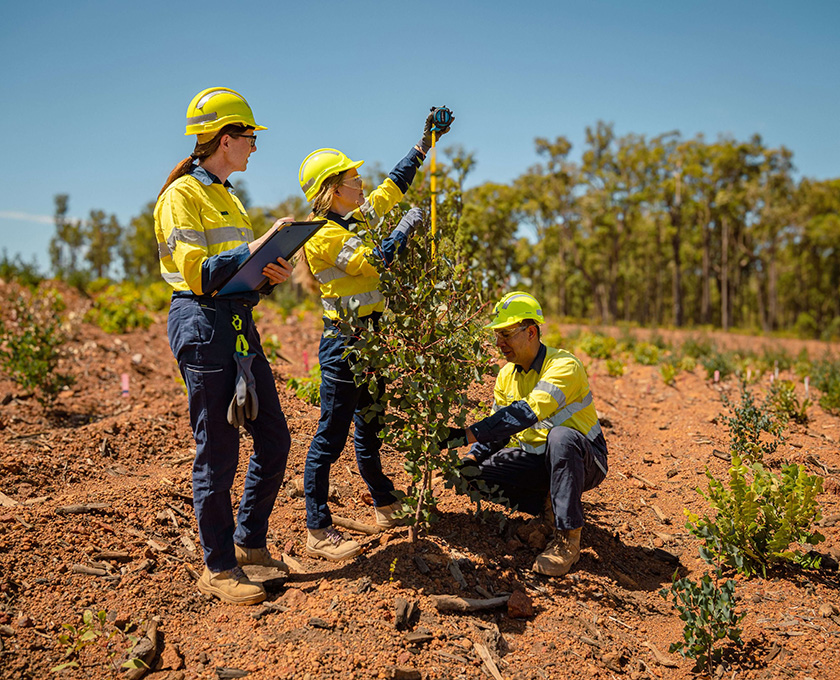
Partnerships between industry, research institutions and environmental practitioners play an important role in strengthening mine rehabilitation practices.
By working collaboratively, these groups are combining operational insight with scientific research to test new approaches, address shared challenges and build an evidence base that supports long-term ecosystem resilience in a changing climate.
This collaborative approach is demonstrated through two environmental research projects supported by the Cooperative Research Centre for Transformations in Mining Economies (CRC TiME), where industry and research partners are jointly piloting and refining rehabilitation techniques in operational settings at our Willowdale bauxite mine.
Climate adapted seed sourcing
One of the trials focuses on the effectiveness of sourcing seeds of particular species from a range of different climatic zones to determine if revegetation success can be enhanced in a changing climate. Willowdale is one of five trial sites across Australia participating in the study.
At each site, native plant species have been sourced from a range of environments, including areas close to the trial site and warmer, drier regions, to assess their adaptability to future climate conditions.
At Willowdale, jarrah and marri seedlings raised at Kings Park Science’s Perth nursery were grown from seed sourced both locally to the mine and from regions further north and east. Banksia and hakea seeds were also planted. Growth and survival rates will be monitored over the coming years, with a particular focus on performance through extreme or prolonged weather events.
CRC TiME CEO Dr Guy Boggs, said the Willowdale trial is an important part of the work underway to fill in current knowledge gaps.
“Creating resilient ecosystems in the face of climate change is a national issue,” Dr Boggs said.
“The scope of our climate-adapted seed sourcing project allows us to explore local and national solutions, with experimental planting sites in south-west WA, the Pilbara, the Bowen Basin, Adelaide and north-west Tasmania.
“This study is a global first as alternative seed-sourcing strategies have not previously been tested in the field.”
Australian Seed Scaling Initiative Project
This project is using agricultural seeding technology to scale up and improve seed application across post-mining areas.
The team is examining optimal seed burial techniques and testing a range of seed treatments aimed at improving germination and survival rates for key species in complex rehabilitation environments.
Alcoa Research Manager Dr Lucy Commander said the value of collaboration could not be understated.
“These projects are a prime example of the value of bringing industry and research organisations together in the interests of continuous improvement and adaptive management,” Lucy said.
“By jointly identifying opportunities to improve performance, increase efficiency and enhance resilience, we are unlocking more pathways for long-term success and sustainability, supporting returning ecosystem function to areas following other land uses.”
A report on findings from the climate adapted seed sourcing project is available on the CRC TiME website.
View other articles in this edition.