World’s Leading Producer of Aluminum

Worldwide
Sustainability 
Sustainability ApproachSustainability of ProductsSustainability of ResourcesSustainability of Operations
Sustainability Overview

Take survey
Overview
Environmental
Social
Economic


Sustainability of Products


Sustainability is critical for Alcoa’s business success and for the success of our customers. Our products play a significant role in the continuing, sustainable life and health of our planet.


The electrolytic process for extracting aluminum from bauxite ore was first developed in 1888. Because aluminum is infinitely recyclable, approximately 75% of the metal ever produced since that year is still in use today. The inherent qualities of aluminum—high strength, light weight, and durability—make it one of the world’s most sustainable materials. These qualities help our customers’ products become more sustainable as well.


At Alcoa, we are constantly focused on better understanding and improving the sustainability of our products. We are also involved in developing new and improved products and processes to increase both the amount of aluminum used throughout the world and that which can be recovered for recycling. In fact, aluminum is the most sustainable and recyclable automotive, packaging, and construction material in today’s market. Every time aluminum is recycled, it uses 95% less energy than when it was first made—preserving precious energy resources.


As part of our continuous-improvement efforts, we use life cycle assessments to better understand how we produce aluminum, the lifespan of its use in our customers’ products, and how it is recycled for future use. What we’ve found is that during a product’s life cycle, aluminum can improve energy efficiency and reduce carbon dioxide emissions, lessening our environmental footprint and that of our customers.


In today’s world, where the dominant trends are population growth, urbanization, and growth of energy demands, aluminum is an ideal material. Strong but lightweight, it is an essential component of green buildings in fast-growing urban areas. It improves fuel efficiency and emissions reductions in all modes of transportation. Because it is infinitely recyclable, it is the perfect material to reduce waste in overburdened landfills.


Here are some highlights of the contributions aluminum makes to sustainability in four key market sectors.


Packaging

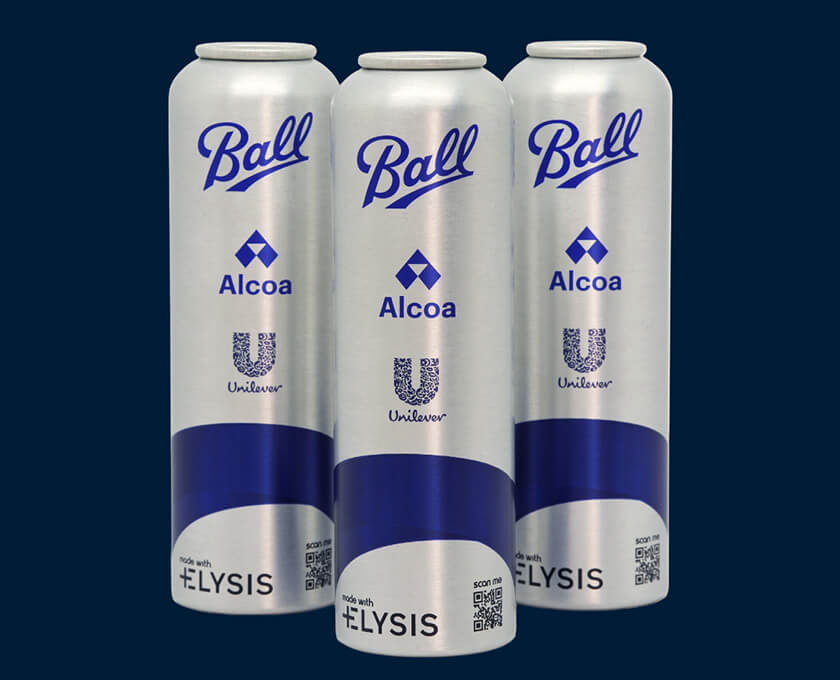
  • The aluminum beverage can is the world’s most recycled container—69% of all cans were recycled worldwide in 2010. (International Aluminium Association).
  • In the United States, 57% of aluminum cans were recycled in 2010 (based on 2009 data) compared to 28% for plastic and 28.1% for glass. (http://www.napcor.com, http://www.gpi.org)
  • Beverage containers represent less than 20% of the materials collected in curbside recycling programs, but they generate up to 70% of total scrap value. (www.alcoarecycling.com)
  • A recycled aluminum beverage can is back on the store shelf in 60 days. (Aluminum Association)


Transportation

  • Road transport contributes 12% of global greenhouse gas emissions (GHG). A 10% reduction in a car’s weight through the use of aluminum can result in a 7% reduction in the vehicle’s GHG emissions. (www.autoaluminum.org)
  • Lightweighting the world’s transportation fleet—passenger cars, trucks, rail vehicles, air, and sea craft—has the potential of reducing GHG emissions by 660 million tons annually, or close to 9% of global, transportation-related GHG emissions. (www.autoaluminum.org)
  • Replacing two pounds (0.9 kilograms) of steel with one pound (0.45 kilograms) of aluminum in a car can save up to 20 pounds (9.0 kilograms) of carbon dioxide (CO2) emissions over the life of the car. (http://www.auto.aluminum.org)
  • Aluminum-structured hybrids can receive a 13.5% increase in fuel economy over a steel-bodied hybrid. An aluminum-bodied diesel has a 13.1% improvement in fuel economy when compared to the steel-bodied diesel vehicle. (Aluminum Association)
  • An aluminum wheel can improve tire rolling resistance by up to 3% over a comparable size steel wheel. A 3% decline in rolling resistance equals a 1% fuel savings. (www.autoaluminum.org)
  • Nearly 60% of aluminum used on today’s vehicles is sourced from recycled metal. (www.autoaluminum.org)
  • On average, aluminum can save 18 tons of CO2 for every ton of aluminum added to a commercial vehicle fleet. (www.autoaluminum.org)


Building & Construction

  • 95% of aluminum in buildings is recycled. (greenbuilding.world-aluminium.org)          
  • A six-story office building using sustainable aluminum products can drive up to 20% energy savings over a similar building—saving 157 tons of CO2 per year over its 50 years of use. (Paladino Study for Alcoa, 2008)
  • Aluminum's unmatched recyclability gives architects the ability to design with cradle-to-cradle life cycles in mind to help achieve green building standards.
  • Aluminum roofs, which can reflect up to 95% of the sun’s light, can dramatically lower summertime attic temperatures, resulting in lower air conditioning expenses. (Aluminum Association) 
  • Alcoa’s aluminum building products are made from alloys that are weather-proof, corrosion-resistant, and immune to harmful effects of ultraviolet rays.


Consumer Electronics

  • Alcoa offers aluminum alloys for the consumer electronics market that are made from 25% recycled content and 20% lower in carbon emissions.
  • Aluminum generates 20% less CO2 than ABS plastic in cell phones. (Alcoa analysis)
  • Because aluminum is more efficient at transferring heat than plastic, an aluminum laptop (without a fan) can be 20% more energy-efficient than plastic, with a 20% longer battery life.
  • Aluminum from a laptop can be recycled infinitely without degradation into another laptop or other high-value product. Plastic degrades when it is recycled.
  • 76% of Americans consider recycling to be the best option for reducing e-waste. (Pike Research study “Electronics Recycling and E-Waste Issues”, November, 2009. www.ce.org)


Our Products 

We are the world’s leading producer of primary aluminum and fabricated aluminum, as well as the world’s largest miner of bauxite and refiner of alumina. Among the solutions we market are flat-rolled products, hard alloy extrusions, and forgings, as well as Alcoa® wheels, fastening systems, precision and investment castings, and building systems in addition to our expertise in other light metals, such as titanium and nickel-based superalloys.


Learn more about the products and capabilities we offer.


Non-Aluminum Products

Although the majority of our business involves the mining, refining, smelting, and fabrication of aluminum products, we are also a leader in several multi-material businesses that substantially contribute to sustainability. 


Alcoa Power and Propulsion manufactures castings in a variety of materials, including titanium, cobalt- and nickel-based superalloys, and steel, for the aerospace and industrial gas turbine markets. Alcoa Fastening Systems provides fastening-system solutions using a variety of metals and materials for the aerospace, automotive, and commercial transportation markets. We also use a variety of alloying materials in many of our other businesses to enhance the sustainable qualities and attributes of our aluminum products.


Our non-aluminum businesses, like our aluminum businesses, produce products that contribute to sustainability in key market sectors.


Industrial Gas Turbine

  • Sophisticated coating technologies and lighter-weight components allow increased turbine temperatures and more efficient fuel consumption for overall energy savings and performance enhancement.


Aerospace

  • Innovative casting technologies eliminate the need for costly, multi-component fabricated assemblies, reducing both weight and waste.
  • Aerospace fasteners exhibit critical dimensional characteristics with tightly controlled tolerances to support expansive wingspans and critical stability components.
  • Titanium fasteners with high strength-to-weight ratio enable fuel efficiency in the latest aircraft.
  • Advanced casting systems, single-crystal technology, and advanced coating processes enable engine components to withstand extreme temperatures, increasing performance and improving fuel efficiency.


Learn more about our non-aluminum products and their sustainability attributes.

Copyright © 2012 Alcoa Inc.
country sites

customer login