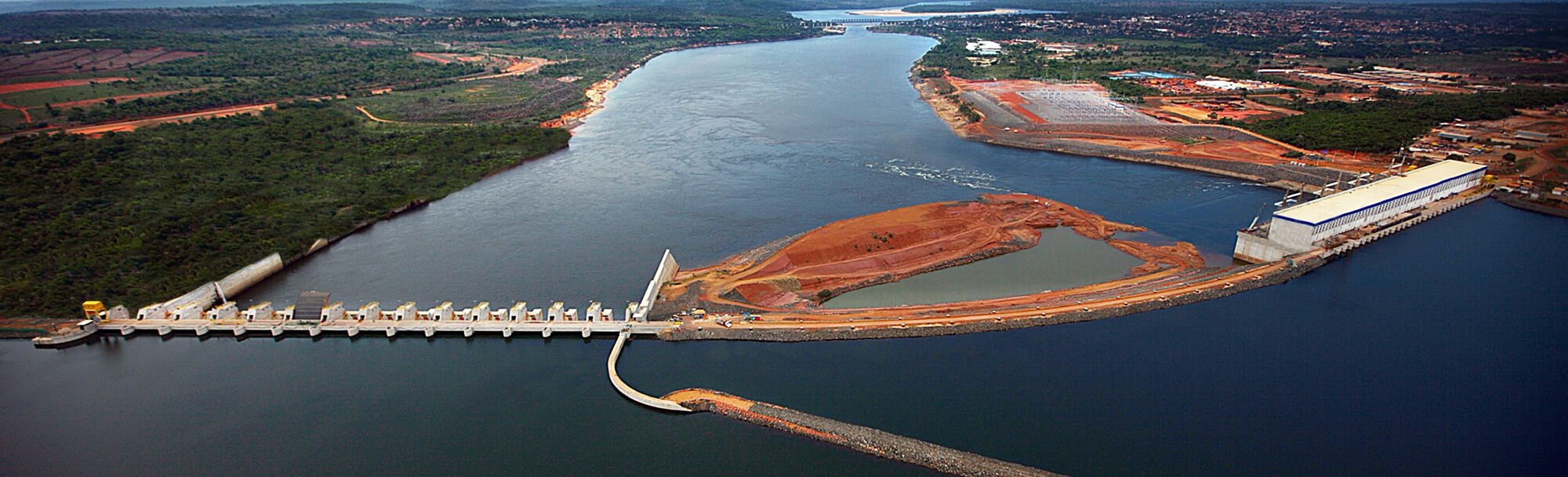
Located on the Pelotas River, between Anita Garibaldi (SC) and Pinhal da Serra (RS), the Energética Barra Grande S.A. (BAESA), started being built in May 2001 by a consortium of five companies: Alcoa Alumínio S.A., with a 42.2% share, Companhia Paulista de Força e Luz (CPFL), with 25%, Companhia Brasileira de Alumínio (CBA), with 15%, Camargo Corrêa Cimentos with 9%, and DME Energética with 8.8%.
On November 1, 2005 the first hydroelectric generating unit came on stream. In February 2006 the second unit was also activated and three months later, in May, the third and final unit went into operation, thus producing the maximum installed capacity of 708 megawatts. With this capacity the power station generates sufficient energy to supply nearly 30% of the power demands of Santa Catarina, or 20% of the total input consumed in Rio Grande do Sul. Each unit can generate 236 megawatts.
Although its initial objective was to generate power, BAESA achieved much more than could be imagined: it also generated income, employment, opportunities, quality of life, motivation and prospects, such as the IBENS (Brazilian Institute of Education in Sustainable Business) income generation program. On January 11, 2008, because of its social responsibility activities, BAESA was able to renew its Operating License (OL), issued by IBAMA (Brazilian Institute of the Environment and Renewable Natural Resources) for a further six years.
In search of sustainability and reliable energy over the long term Alcoa believes that the installation of BAESA represents an important step for Brazil and the country’s aluminum industry. In addition to the investments of around R$ 1.5 billion the hydroelectric power station will also call for a further R$ 200 million in compensation measures aimed at social and environmental projects.
Furthermore, the power station has signed a Term of Commitment with IBAMA to introduce actions for preserving the environmental heritage of federal, state and municipal conservation units, in line with the National System of Nature Conservation Units Law
(SNUC).