 |
 |
|
 |
 |
 |
 |
World Class Rehabilitation
Before bauxite mining begins, surveys of the existing flora, fauna and forest health are undertaken. Results enable the identification of environmentally sensitive areas and ensure that appropriate steps will be taken to minimise the impact of mining. These environmental considerations are incorporated into the final mine plans, which are submitted to government for approval. The bauxite mine rehabilitation program involves:
- Reshaping mined areas to blend with the surrounding landscape.
- Building earthworks to control run-off from the rehabilitated area.
- Returning topsoil and logs to help in flora and fauna return, and to maximise soil nutrients.
- Contour ripping subsoils to assist in tree root penetration, maximise water infiltration and assist in erosion control.
- Seeding tree, understorey and other species indigenous to the jarrah forest. Jarrah is the major species in all rehabilitation.
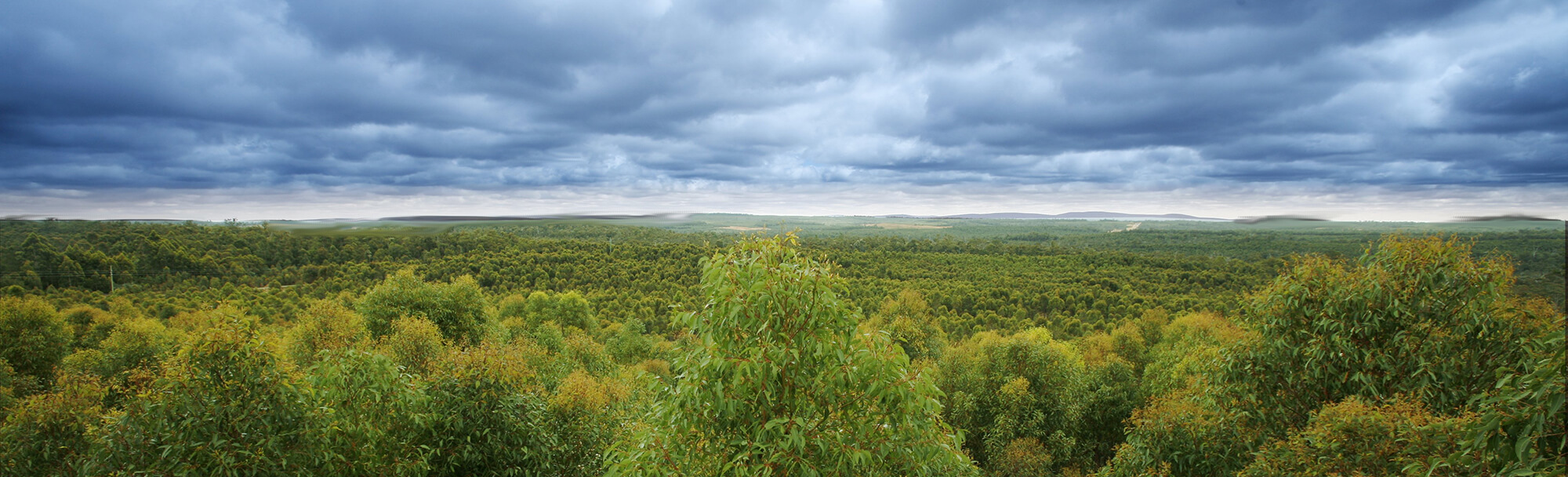
Application of nitrogen and phosphate fertiliser, usually by helicopter. For every million tonnes of alumina it refines from bauxite, Alcoa clears, mines and rehabilitates 75 hectares of land in the Darling Range. More than 10,500 hectares have so far been revegetated, with rehabilitation costs to Alcoa currently averaging $20,000 a hectare. A total of $13 million is spent annually on research, planning, environment operations and rehabilitation. Alcoa and W.A's Department of Conservation and Land Management pioneered the rehabilitation program that we now operate. It has required special research and development work to suit the specific soil and climatic conditions in the area, and to protect healthy jarrah forest against the dieback fungus, Phytophthora cinnamomi. Since mining commenced, Alcoa has cleared about 12,400 hectares for all mining and related purposes, which is equivalent to 0.6 percent of Western Australia's 2 million hectares of public and private jarrah-marri forest. The annual clearing rate of about 550 hectares compares with some 14,000 hectares of jarrah forest harvested each year for timber industry products. The Company encourages public inspection of its mining and rehabilitation operations, and more than 500,000 people have taken advantage of free public tours. The current rehabilitation objective is to re-establish a jarrah forest ecosystem after bauxite mining. More than 96 percent of floral species, including all the dominant tree species, are currently being successfully re-established. The rehabilitated areas are rapidly recolonised by native insects, and as it matures it becomes increasingly used by animals and birds. For example, one of W.A's rarest animals, the Noisy Scrub-bird was introduced by CALM in 1997 into stream zones at the Willowdale mine. This is an area where it was first discovered 150 years ago. The success of this experiment led to further releases each year since 1997. The species disappeared soon after European settlement and was thought to be extinct until its rediscovery 35 years ago at Two Peoples Bay near Albany. On World Environment Day in June 1990, Alcoa was listed on the United Nations Environment Programme's Global 500 Roll of Honour for environmental achievement in mine rehabilitation. Alcoa is the only mining company in the world to have obtained this recognition, which reflected more than two decades of environmental research and development.
|
 |


|
|
 |