Energy Use in Victoria
There is a misconception among some that Alcoa receives a subsidy from the Victorian Government as part of the complex energy supply agreements between the two parties. This is not true. When the Portland Aluminium project was given approval in the 1980s, power contracts were put in place for both Portland Aluminium and the Point Henry smelter. Under the contracts, the power tariff paid by Alcoa increases and decreases in line with the world aluminium price which is represented by the London Metals Exchange (LME). These contracts last until 2014 (Point Henry) and 2016 (Portland Aluminium). The flexible tariff arrangements effectively shared the risk of Alcoa building the Portland Aluminium smelter at a time of low global aluminium prices. The tariff and arrangements under these contracts offered two major advantages to the Victorian Government and community:
- It allowed the State to share in the economic benefits of the aluminium industry; both good and bad. It shared the profits when the LME was high (and profits were high), and allowed the smelters to keep operating when the LME was low.
- It ensured Loy Yang (Victorian power station) would not have to reduce its generating capacity during down-times in the global aluminium market. In turn, it avoided a substantial increase in Loy Yang’s average cost of power.
Any increase in power costs would have been passed onto Victorian industry and households. The continued smelter operation resulted in a much lower average cost of power. The privatisation of Victoria’s power industry in the 1990s resulted in the Victorian Government receiving over $8 billion from the sale of assets directly linked to the Portland Aluminium project. As a result the project has delivered the Victorian Government a return of 5.1 per cent, exceeding the Government’s goal of 4 per cent.
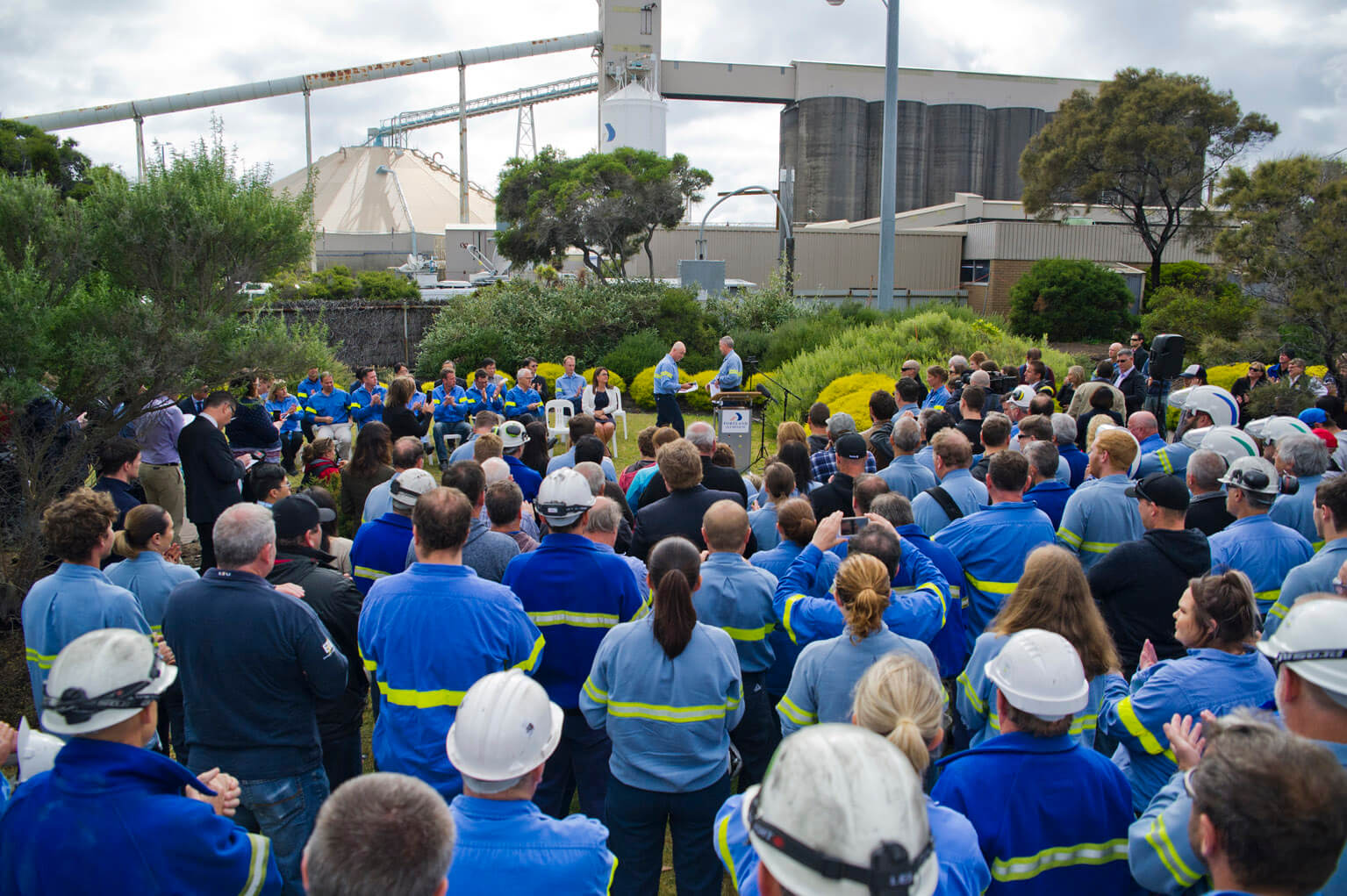
New Power Deal for our Victorian Smelters On 1 March 2010, Alcoa of Australia and Loy Yang Power announced new base-load electricity contracts to power Alcoa’s smelters at Point Henry and Portland Aluminium to 2036. Read more. Supporting System Security Alcoa of Australia has an arrangement in place as part of the supply agreement that allows the power system operator to shed Alcoa electrical load at times when there is insufficient power generation to meet the State’s demand, and at times when the electrical system becomes unstable. Alcoa has provided this service for more than 20 years. This process delays the shedding of other customers power supply in the State. We manage these power outages through periodic curtailments at the Point Henry and Portland Aluminium smelters.
Anglesea Power Station Over 90% of Victoria is powered by brown coal. Alcoa has a brown coal mine and power station at Anglesea which supplies around 40% of the power needed for the Point Henry smelter. The Anglesea Power Station runs at benchmark efficiency for a plant of its age, and is amongst the lowest greenhouse gas emissions per megawatt hour for brown coal generators in Victoria. In 2009, Alcoa spent $40 million on essential maintenance at Anglesea and to optimise efficiencies.
The Electricity Allocation Factor (EAF) The proposed Carbon Pollution Reduction Scheme (CPRS) would have seen power station operators experience significantly increased costs associated with permits for their carbon emissions that they would have ‘passed through’ to power purchasers.
For Alcoa, a large user of purchased electricity from a brown-coal source, this ‘cost pass through’ represented a significant additional cost that could prematurely close Australian facilities. Read more about the Electricity Allocation Factor. It is unclear at this stage how these same issues will be handled under the proposed carbon tax. Renewable energy Unfortunately, using renewable energy to power our Victorian operations is not currently a viable option, for a number of reasons. First, there is simply not enough renewable energy available in Victoria to power all our operations in the State. Second, renewable energy is cost prohibitive for Alcoa in Victoria in that switching to renewable sources (if they were available) would render our operations in the State financially unviable . This would in turn have negative flow on effects to the economy, through loss of jobs and investment in local communities. However Alcoa is playing an important role in facilitating the Portland Wind Energy project via the connection of infrastructure. Read more.
In addition, in November 2010, Alcoa of Australia signed a memorandum of intent with Greenearth Energy to help facilitate the development of geothermal energy in Victoria. This is an important move toward the establishment of base-load renewable energy. Read more. It is important to note that Portland Aluminium and Point Henry are two of the most energy efficient smelters in the Alcoa system, and are amongst the most energy efficient smelters in the world by virtue of their technology and the high standard of work practices and energy management strategies that are an integral part of their operation.
|
 |
Powering on to 2036

 Read our commemorative brochure that celebrates the historic signing of new power contracts for our smelters
click here
Video

 Victorian Power Contracts: platform for the future
watch it
EAF

 Find out why the Electricity Allocation Factor is a critical issue for Alcoa in Victoria
click here
|